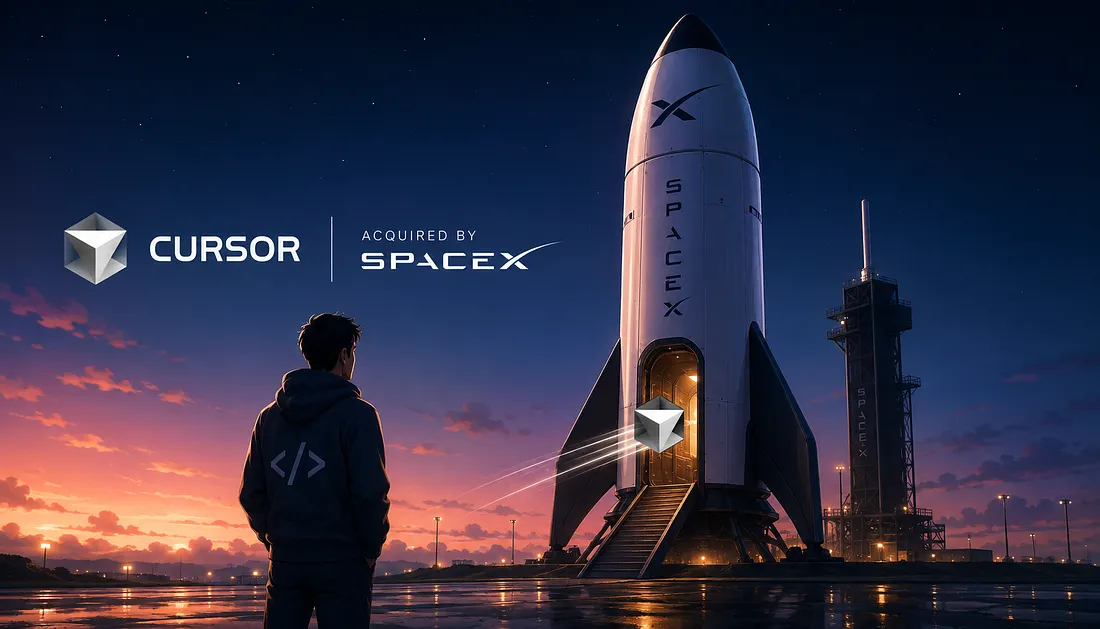
When SpaceX announced it was acquiring Cursor for a staggering $60 billion, my first reaction was simple: Why?
The AI coding space is already fiercely competitive. Giants are constantly dropping new models and terminal agents to win over developers, making a $60 billion price tag feel astronomical for just a code editor. But looking closer, this deal is about much more than a single coding tool.
I actually used Cursor heavily before moving away to Claude Code about a year ago, and honestly, my preference hasn’t changed. I still use Claude Code today.
Even so, this acquisition changes the game. People often dismiss Cursor as a “VS Code wrapper,” but they were early pioneers in this space with years of invaluable user data. Backed by SpaceX’s massive infrastructure, they now have the resources to strike back hard. I don’t know if this guarantees they’ll take over the market, but it makes things incredibly interesting. And for developers, having Cursor back in the fight to push the industry forward is a huge win.
Why I Loved Cursor (And Why It Succeeded)
A common criticism of Cursor is that it is “just a VS Code fork.” But that misses why it worked so well.
VS Code has been the default editor for years. Developers are deeply comfortable with that UI, its shortcuts, and its ecosystem. Cursor’s genius wasn’t in reinventing the interface; it was in keeping that familiar environment intact and seamlessly layering AI on top.
Between the frictionless autocomplete and the ability to easily toggle between different top-tier models in one place, Cursor made AI feel like an extension of your own coding rather than a separate chore. It gave developers the exact bridge they needed.
Why I Moved to Claude Code
About a year ago, though, the landscape shifted.
I decided to try out the Claude Code CLI, and the difference was immediate. Not only was the quality of the output consistently superior for repository-wide reasoning, but the limits were also significantly better for my day-to-day workflow.
A big part of that came down to pure economics. When a platform like Cursor operates as a third-party tool, they have to pay retail API rates to model providers like Anthropic or OpenAI. Those providers naturally bake their own profit margins into the API cost, meaning the raw models always feel more expensive for third-party platforms. Those costs inevitably get passed down to the user through tighter limits or higher subscription prices.
Because Anthropic built the models directly, they didn’t have to carry those external margins, allowing them to offer far more generous limits and pricing. For heavy daily coding, that combination made the switch an easy decision
What SpaceX Actually Wants With Cursor
So, why would SpaceX spend $60 billion on an AI coding tool?
If Cursor were just a smart code editor, that price tag wouldn’t make any sense. But SpaceX isn’t just buying an editor, they are buying the bridge between developers, compute infrastructure, and a massive revenue stream.
To build great AI tools for developers, you really need two big ingredients:
- Real-world developer data: Understanding how real engineers actually write, edit, debug, and navigate code.
- Massive computing power: The raw GPU infrastructure required to train, test, and run advanced models at scale.
Cursor already had the first part. As a first mover, they’ve spent over two years learning how millions of developers work alongside AI. They know what code suggestions developers accept, what they reject, and where workflows break down. That real-world feedback is extremely hard to replicate.
What Cursor lacked was the second part: unlimited computing power. Training custom models and running experiments is insanely expensive. Without deep infrastructure, it is nearly impossible to compete long-term against giants like OpenAI or Anthropic.
That’s the exact missing piece SpaceX provides.
The real value of this acquisition isn’t just “handing Cursor a few GPUs.” It’s about building a powerful feedback loop
SpaceX Compute + Cursor’s Developer Data → Smarter Coding Models → Better Developer Experience → More Users → Even More Feedback Data.
We are already seeing the first signs of this. The market is currently buzzing with strong signals that Cursor is training a massively scaled-up model — dubbed “Composer 3” — leveraging SpaceX’s Colossus GPU cluster. Instead of just fine-tuning other companies’ models, Cursor is now positioned to use heavy-duty compute to build their own custom frontier models designed specifically for software engineering workflows.
Beyond the tech, look at where the money is flowing in AI. In Q2 of 2026, Anthropic reported around $11.75 billion in revenue, while OpenAI sat around $6.25 billion. The big takeaway isn’t just the totals — it’s who is paying. OpenAI’s revenue still heavily relies on casual consumer subscriptions, whereas Anthropic’s surge is powered overwhelmingly by developers, APIs, and enterprise engineering teams.
That tells us everything about this market. Developer AI is an absolute goldmine, and enterprise spending follows where engineers go.
But serving those engineers is brutally expensive. Just recently, OpenAI CEO Sam Altman admitted that the company is actually losing money on its $200-per-month ChatGPT Pro subscription because heavy users consume resources far faster than anticipated. Even at $200 a month, third-party API costs and inference compute are so high that it is tough for companies to maintain profitability on their power users.
This is where Cursor’s new advantage comes in. With SpaceX’s massive hardware backing them and models like Composer 3 in the pipeline, Cursor is no longer just a wrapper paying retail API prices to someone else. They can afford to give users access to top-tier models at discounted rates — just like OpenAI and Anthropic do — because they own the underlying compute. They don’t have to worry about the margins killing them when power users push the limits.
SpaceX’s $60 billion acquisition isn’t a gamble on a code editor. It’s an aggressive move to secure a direct pipeline to the developers driving the most lucrative, fastest-growing segment of the entire AI industry.
Cursor’s ₹649 India Plan Is a Strategic Masterstroke
Another development that caught my attention recently was Cursor’s localized pricing strategy. Just weeks before the SpaceX deal, Cursor launched Cursor Start for ₹649 per month in India, complete with tax-inclusive pricing and native UPI support.
That is considerably more accessible than a standard $20 USD international subscription, which usually costs over ₹1,800 per month once you account for exchange rates and international transaction fees. For developers and startups across India, removing that financial friction makes a massive difference. According to Cursor’s own data, India already boasts their highest concentration of power users globally running more agent requests per seat than anywhere else in the world.
There are obvious limitations to the ₹649 plan. It doesn’t give you access to the expensive third-party frontier models from OpenAI or Anthropic that you get on the higher-tier Pro plan. But it does give you generous limits on Cursor’s in-house models — including Grok 4.5 and Composer — along with cloud agents and their new iOS app.
For me, this pricing tier is the ultimate proof of Cursor’s long-term strategy. They aren’t trying to build an expensive, niche tool restricted to heavily funded enterprise teams. They want to capture the global, grassroots developer audience. And with SpaceX’s massive compute infrastructure now backing them, they can actually afford to scale these cheaper in-house models to millions of power users without bleeding money.
The $60 Billion Question
To be honest, I’m still skeptical.
If you view Cursor purely as an AI code editor, a $60 billion valuation is impossible to justify. But SpaceX isn’t buying software subscriptions — they are buying elite tech talent, a massive developer user base, and years of real-world interaction data that money alone can’t replicate.
When you combine that talent and data with SpaceX’s infinite compute, the goal changes. The question isn’t whether Cursor is worth $60 billion today based on its editor revenue. The question is whether they can use that infrastructure to become the central operating system for software engineering.
If they pull that off, $60 billion might start to make sense. We’ll have to wait and see.
My Take
As someone who moved away from Cursor a year ago, I’m not sitting here expecting them to magically become my default editor overnight. My preference for Claude Code hasn’t changed purely because of a corporate buyout.
But I am intensely curious about where this goes. Cursor now has the keys to arguably the most powerful GPU infrastructure on the planet, combined with the talent and data to actually use it. If that firepower translates into genuinely superior, native models that make daily coding frictionless again, I’ll happily give them another look.
Ultimately, I don’t care whether Cursor, Claude Code, or any other tool “wins” the market. I care about the competition it forces. When major players battle for developers, we all benefit through better agent reasoning, more generous limits, localized pricing, and faster iteration.
If this massive $60 billion bet forces the entire industry to step up its game, then the real winners aren’t just SpaceX or tech giants — they’re the developers writing code every single day.