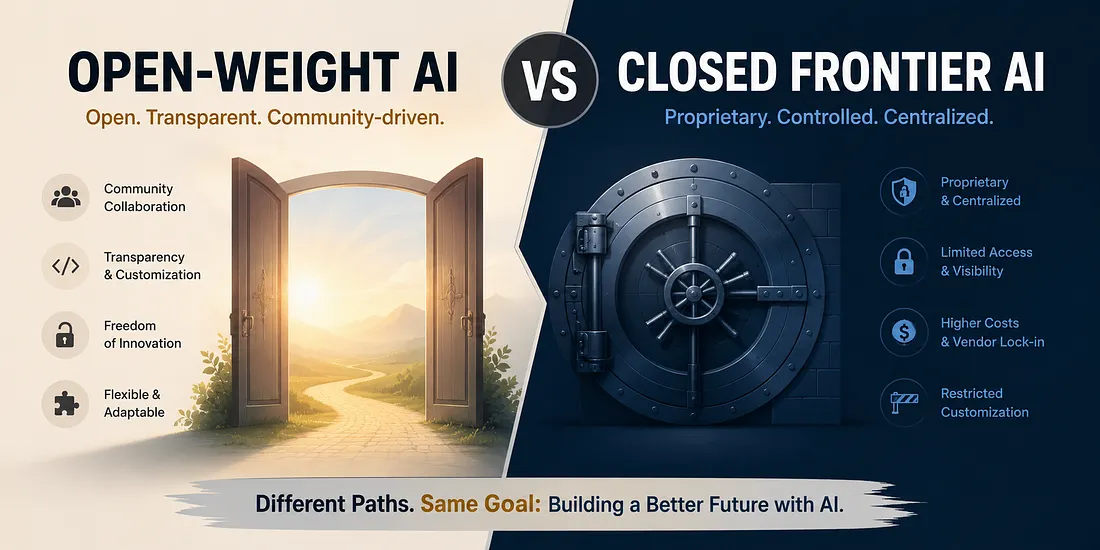
As a developer who has been building with and using AI every single day for over two years, I’ve watched the landscape shift dramatically. Not long ago, the choice between open-weight models and closed frontier APIs was a no-brainer. If you needed serious reasoning or production-grade reliability, you relied on API access to proprietary systems. Open-weight alternatives were great for experimentation, but clearly lagged behind on anything complex.
That dynamic has completely collapsed. Recent open-weight releases from ecosystems like DeepSeek, Qwen, Kimi, and Llama have made the choice genuinely tough. Open models are now competing with and in many cases matching top-tier closed APIs at a fraction of the operating cost.
As a result, the conversation in my daily workflow has shifted. It’s no longer just a question of “which single API is the smartest?” — it’s about control, architecture, and cost efficiency.
Before looking at how to navigate this new ecosystem, we first need to step back, clarify what these terms actually mean, and examine the real trade-offs between them.
What is an open-weight model?
An open-weight model is an AI model whose trained weights the billions of numerical values learned during training are made available for others to download and run themselves.
For example, a model may be trained to answer that Paris is the capital of France. There isn’t one specific “Paris weight”; that knowledge is distributed across many parameters. If someone downloads the model, they can fine-tune it with new data and potentially change how it behaves.
This is also where the safety debate comes in. The original developer might train the model to refuse harmful requests, but another developer can download the weights and fine-tune the model with different data to encourage different behavior. The original developer therefore loses some control over how the model is ultimately used.
And open-weight doesn’t necessarily mean open-source: the weights may be available while the training data, training process, or source code remain private.
Open-weight doesn’t necessarily mean open-source
This is an important distinction. People often use “open-source AI” and “open-weight AI” interchangeably, but they aren’t necessarily the same thing.
With an open-weight model, you get the final trained weights that you can download and run yourself. But you may not get everything that was used to create the model, such as the training data, training code, data-processing pipeline, or the exact training recipe.
A simple way to think about it is: open weights give you the finished engine, but not necessarily the blueprints and factory that built it.
That’s why, when talking specifically about models whose trained parameters are available for download, “open-weight” is often the more accurate term.
What are closed frontier models?
A closed frontier model is an AI model that is among the most capable models available, while its trained weights are kept private by the company that created it.
Models like Claude Opus, Gemini, and OpenAI’s flagship models are examples. You can send them an input through their app or API and receive an output, but you don’t get access to the actual weights. This means you can’t download the model, run it on your own infrastructure, or directly fine-tune its weights. The company controls how the model is trained, deployed, and accessed.
In simple terms, the company owns and controls the trained model, while you get access to its capabilities through the company’s infrastructure.
Closed doesn’t automatically mean safe
It is easy to assume closed means safe, but that’s not necessarily true. A closed model can still have vulnerabilities, be manipulated, or be misused.
Open-weight models have a different advantage: visibility and control. Since you can download the weights and run the model on your own infrastructure, you have more ability to inspect and audit what you’re actually running. You also have more control over what happens to your data and requests.
With a closed model, you send your input to the company’s infrastructure and receive the output, but you have much less visibility into what happens behind the API, how your data is processed, and what other systems are involved.
So both have trade-offs: open models provide more access, customization, competition, and control, while closed models provide more centralized control over safety and access.
Why I think we need both
I don’t think the future should be everything must be open, and I don’t think it should be everything must be controlled by a few AI companies.
I think we need both.
Closed frontier models have one big advantage: companies can keep improving them and quickly fix problems when something goes wrong. Fable is a good example. When a security issue was found, access could be restricted while the problem was addressed. The company can then improve the model and release a safer version.
If that model had been open-weight from the beginning, people could have already downloaded the model with that vulnerability. Even if the company fixed the problem later, it couldn’t take those copies back.
This is why I think closed models can continue pushing the boundaries first, while open-weight models can catch up and make those improvements available to more developers.
And an open model doesn’t necessarily need to beat the best closed model. It just needs to be good enough for most real-world tasks.
If an open model can handle most of what a company needs at a fraction of the cost, that creates real competition and ultimately gives developers more choices and brings costs down.
My verdict
I don’t think the question is “Should AI be open or closed?” That’s too simple.
The better question is “What should be open, and how capable should a model be before its weights are released?”
For smaller and specialized models, I strongly support openness. It gives developers more freedom to experiment, build, and run AI on their own infrastructure. But as models become more capable, I think we need much more careful safety evaluation before releasing their weights.
At the same time, I don’t want a future where only a few companies control the most powerful AI systems. That creates its own risks.
So my position is somewhere in the middle:
- We need closed frontier models to keep pushing the limits of what AI can do.
- We need open-weight models to make increasingly capable AI more accessible.
- We need strong safety research around both.
- And most importantly, we need competition between them.
But I think there is another important shift coming. The future may not be about choosing one model.
Instead of asking:
“Which model is the smartest?”
we may start asking:
“How do I build the best system using different models?”
A frontier model could handle the hardest reasoning, an open model could handle most everyday tasks, a specialized model could handle coding or vision, and a local model could handle sensitive data.
The winning system may not be a single AI model. It may be an ecosystem of different models working together.
And that’s another reason I believe open-weight models matter. They give developers the freedom to build that ecosystem rather than depending entirely on one provider.
Competition doesn’t just make AI cheaper it gives developers choices, pushes companies to improve, and prevents the future of AI from becoming dependent on a handful of companies.
For me, the future isn’t open vs. closed. It’s both pushing each other forward.