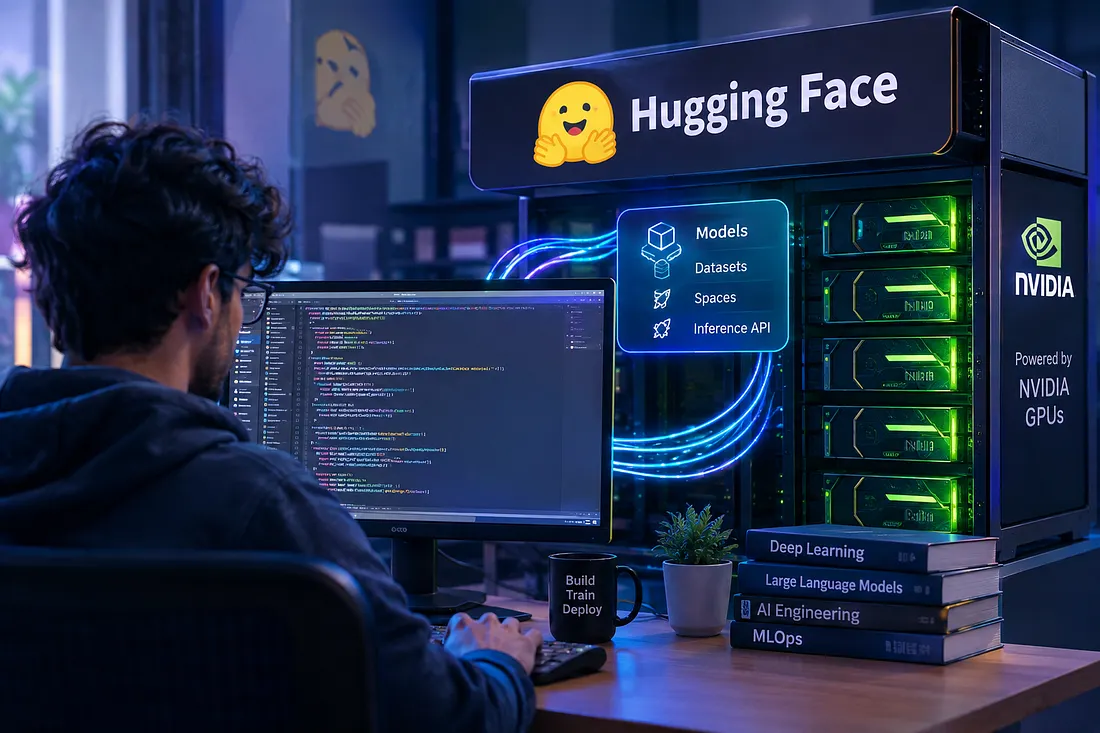
For the past few years, using AI has mostly meant calling an API — sending a prompt to a powerful AI model and getting an answer back. But companies don’t all work in the same way. They have their own code, rules, processes, and ways of doing things. A general AI model cannot always understand all of that.
I think we are moving toward a future where companies won’t just use AI from outside providers. They will also build and customize AI to work better for their own needs.
The biggest signal that this change is happening? Nvidia’s reported $12.9 billion acquisition of Hugging Face.
But this isn’t really an article about Nvidia buying Hugging Face.
The acquisition is simply what got me thinking about a much bigger question: how will companies build and use AI over the next few years?
What I’m exploring here is my own view of where AI could be heading — from open-weight models and fine-tuning to AI chips, compute, specialized models, and company-specific AI systems.
The Nvidia–Hugging Face deal is interesting because it brings many of these things together. It gives us a way to think about where AI models are going, how companies could customize them, and why the hardware and infrastructure running AI could become just as important as the models themselves.
So rather than looking at this acquisition only as a business deal, I want to look at what it could tell us about the future of AI and how software will be built.
What Hugging Face Actually Is (and Why the Valuation Makes Sense)
Before getting into what makes Hugging Face so valuable, it is worth looking at the numbers. Hugging Face reportedly generates roughly $150 million in annualized revenue and is nearing profitability. The company was valued at around $4.5 billion in 2023, while Nvidia has reportedly agreed to acquire it for $12.9 billion. That is roughly an 86x revenue multiple, which would look enormous for a traditional software company. But Hugging Face isn’t really a traditional software company, and that’s where things get interesting.
If you haven’t used Hugging Face before, the easiest way to think about it is GitHub for AI models. Developers and researchers can discover open-weight models, download them, experiment with them, fine-tune them with their own datasets, and even publish their modified versions for others to use.
But Hugging Face has grown beyond being a place to store models. It has an ecosystem around datasets, model training, evaluation, inference, and AI applications. It also provides access to cloud compute, including GPU-backed infrastructure, so developers don’t necessarily need to own an expensive GPU or build their own infrastructure just to experiment with or fine-tune models.
For example, you could take an open-weight model like Qwen or DeepSeek, use cloud GPU compute to fine-tune it for a specific task such as frontend development, evaluate how well it performs, and publish your customized version on Hugging Face. Someone else can then discover that model, download it, build on top of it, or create their own version.
That makes Hugging Face interesting not just because of the models it hosts, but because of the community and workflow built around those models. And that is an important part of understanding why Nvidia might be interested in it.
The Part I Think People Are Missing
Nvidia already dominates one of the most important layers of the AI stack: compute. Its GPUs power a huge portion of today’s AI training and inference workloads.
But I think something bigger is happening underneath the AI boom. The competition is no longer just about who builds the best AI model. It is increasingly about who controls the compute needed to build, train, and run those models.
Google has been developing its own Tensor Processing Units (TPUs) for more than a decade. Amazon has Trainium, OpenAI is working on its own chip, named Jalapeño, and Anthropic is expanding its use of Google TPUs and Amazon Trainium alongside Nvidia GPUs.
We’re also seeing powerful AI compute move closer to the developer. Apple recently launched the M5 Ultra, with up to 512GB of unified memory and 1.2TB/s of memory bandwidth, explicitly positioning it for local AI workloads. At the same time, SpaceX and Tesla have announced Terafab, a semiconductor manufacturing facility in Texas with an initial investment of $16.8 billion, aimed at producing advanced logic and memory chips for workloads including Optimus robots and future space-based data centers.
Think about what that means. Companies aren’t just asking “Which AI model should we use?” They are increasingly asking “What hardware should run it?”, “Where should it run?”, and even “Should we control the entire stack ourselves?”
But there is another competitor Nvidia cannot ignore: China.
The release of DeepSeek in 2025 was already a major warning sign. DeepSeek demonstrated that highly capable AI could be developed with a radically different approach to cost and compute efficiency, triggering a massive selloff in Nvidia and forcing the industry to rethink how much compute frontier AI might actually require.
And now we’re seeing another interesting example.
In August 2026, a mysterious model called Ox Alpha appeared on OpenRouter and OpenCode. It was offered for free and reportedly had capacity for around 100 trillion tokens per day, which it served to users without any major issues. What made it particularly interesting wasn’t just its coding and reasoning performance. It was the hardware underneath it.
Z.ai later confirmed that Ox Alpha was an anonymous preview of its GLM-5.3-Flash model, and reports indicate that the model was running entirely on Chinese-made AI chips.
That is an important signal.
The AI race isn’t simply about whether Chinese companies can build competitive models. It is also about whether they can build competitive AI systems without depending on Nvidia’s hardware ecosystem.
Put all of this together and Nvidia is facing a much more competitive environment than it did a few years ago: Apple is building increasingly powerful local AI silicon, Google and Amazon are developing their own accelerators, major AI labs are exploring custom chips, Tesla and SpaceX are moving toward vertically integrated semiconductor manufacturing, and Chinese AI companies are showing that capable models can increasingly run on domestic hardware.
I wouldn’t call this a crisis for Nvidia. Nvidia still has an enormous advantage through its GPUs, CUDA ecosystem, networking, software stack, and developer adoption.
But it does create a much more interesting question about where Nvidia’s future growth comes from.
If Nvidia’s future depends not only on selling GPUs to a handful of frontier AI labs, but on creating more AI workloads across millions of developers and enterprises, then the open-weight ecosystem becomes strategically important.
The more developers experiment with open-weight models, the more companies customize them, and the more AI systems move into production, the more compute the industry could require.
Nvidia doesn’t necessarily need every company to buy a massive GPU cluster.
It needs the world to keep finding new reasons to compute.
And this is where Hugging Face could matter.
Hugging Face sits much closer to the developers experimenting with models, datasets, fine-tuning, evaluation, and deployment. If Nvidia can connect that developer ecosystem to its compute ecosystem, it potentially gets access to something much bigger than today’s frontier AI market.
It gets access to the long tail of AI: millions of developers, thousands of enterprises, specialized models, local models, enterprise models, agentic workloads, robotics, autonomous systems, and eventually AI systems running everywhere from a developer’s desktop to a data center, a vehicle, a robot, or even a satellite.
The question is no longer just how many GPUs Nvidia can sell to the biggest AI labs.
It is how many new AI workloads it can help create across the rest of the world.
Open-Weight AI Changes the Equation
For a company that wants to use AI today, the easiest option is still to use a model from OpenAI, Anthropic, Google, or another provider. You send an API request, pay for the usage, and get an answer. For many companies, this will continue to be the right approach.
But open-weight models introduce a different possibility: instead of simply using a model, you can take it and adapt it to your own needs.
And I’m not saying frontier models aren’t good. They are incredibly capable. For complex reasoning, architecture decisions, planning, or tasks where failure is expensive, using the best model available can absolutely make sense.
But think about it like hiring people.
You might have someone like Elon Musk who is exceptionally capable across many different areas and can take on extremely complex problems. But that doesn’t automatically mean he is the best person for every single job — and he would obviously be much more expensive as well. Someone else might not have the same overall breadth of knowledge, but could be an exceptional frontend developer, designer, tester, or database engineer. You could even hire a team of specialists across these different areas and still potentially spend less than relying on one extremely expensive generalist to do everything. For a particular job, a specialist could simply be the better choice, both in terms of capability and cost.
AI models can work in a similar way.
Models like Opus or Fable may be incredibly capable general-purpose models, but that doesn’t mean they will always be the best choice for every task. A less expensive model might be better at a particular type of work. One model might be particularly strong at coding, another at design, and another at reasoning or data analysis.
So the question shouldn’t always be “Which model is the smartest?”
It should be:
“Which model is best at the job I need to get done?”
If the task is simply changing a React component, fixing CSS, modifying HTML, or implementing a small frontend feature, using the most powerful model available can be unnecessary. A smaller model specifically optimized for frontend development could potentially handle the task just as well — at a fraction of the cost.
And this isn’t only useful for companies. Individual developers can do the same thing. You could take a relatively small open-weight model, experiment with different datasets and fine-tuning techniques, and make it exceptionally good at one particular task. Instead of paying for a powerful frontier model every time, you could run your own specialized model locally or on inexpensive cloud compute.
A small model that is exceptionally good at one job could therefore sometimes be more useful — and far cheaper — than a massive model that is good at everything.
This is where Hugging Face becomes particularly interesting.
Instead of asking “What is the most powerful AI model?”, developers and companies can start asking:
“What is the best model for this particular job?”
Hugging Face already makes it possible to discover models built for different tasks and domains. As this ecosystem grows, we could see increasingly specialized models for frontend development, backend engineering, testing, customer support, legal workflows, data analysis, and many other use cases.
The future may therefore not be about replacing one giant model with another. It could be about using the right model for the right job — a frontier model when the problem requires deep reasoning, and a smaller specialized model when it doesn’t.
And once companies start thinking this way, the next question naturally follows:
“What if we could take one of these models and make it understand how our company works?”
That is where company-specific AI becomes really interesting.
The AI Compute Race Is Getting Much Bigger
There is another side of this shift that I think is easy to overlook: how much AI compute the world may eventually need.
Today, most of the AI compute discussion is about a small number of companies training huge frontier models. But specialized AI could change that.
Imagine millions of developers and businesses running models for their own needs. A developer might run a small coding model locally. A company might run a customized model for customer support, testing, document processing, analytics, or software development.
Each of these models might need far less compute than a frontier model.
But there could be millions of them.
This means AI compute demand doesn’t have to grow only because models become bigger. It can also grow because more people start running more models for more tasks.
We saw something similar with cloud computing. The cloud became huge not just because a few companies needed massive servers, but because millions of businesses and developers started running workloads they previously couldn’t justify running themselves.
AI could follow a similar path.
A specialized model might be smaller and cheaper than a frontier model, but if it is running across thousands or millions of applications, the total compute required can still become enormous.
The AI industry could therefore move from a world where a few companies consume massive amounts of compute to one where millions of companies and developers consume smaller amounts of compute.
And that could make the AI infrastructure market much bigger than it is today.
The winners won’t just be the companies with the fastest chips. They will also be the ones that make AI compute cheaper, more efficient, easier to access, and easier to deploy.
We may be moving from an era of bigger models to an era of more models.
What If Your Company Could Train Its Own AI?
Now imagine a large company with thousands of developers and years of internal engineering knowledge.
The company has its own way of structuring React applications, organizing TypeScript projects, writing APIs, testing code, and enforcing security. Over time, these practices become part of the company’s engineering culture.
Today, we mostly teach AI about these practices by giving it more context — documentation, repository files, coding guidelines, examples, and instructions through things like CLAUDE.md and AGENTS.md.
But with this approach, the AI is still somewhat like a new developer who has just joined the company. Every time a new task starts, you are giving it the rules and instructions again. Those instructions take up part of the context window, leaving less room for the actual task and code it needs to work with.
It is almost like hiring a new developer and sitting with them every time they get a task, explaining the company’s coding practices and rules all over again. That takes both time and money.
But there is a difference between telling an AI how your company works and teaching an AI how your company works.
Imagine a model trained on carefully selected examples from the company’s code, code reviews, accepted pull requests, testing patterns, and engineering decisions.
A developer could then simply say:
“Build me an admin dashboard for this application.”
The model could already understand much of the company’s preferred architecture, coding patterns, naming conventions, and testing approach.
This is similar to what happens when a new developer joins a company. On their first day, they need to learn the codebase, understand the architecture, and learn the team’s way of working. After a few years, much of that knowledge becomes natural to them. They have learned not just the rules, but also the decisions and lessons behind them.
A company-specific AI could move toward something similar. It could gradually build an institutional memory from the work happening inside the organization.
It wouldn’t replace developers. Engineers would still make architectural decisions, review the output, handle unusual problems, and decide what should actually be shipped.
But the AI could start each task with something extremely valuable: an understanding of how this particular organization builds things.
And that could become a major competitive advantage.
The real advantage may not be having access to an AI model that everyone else can use. It may be having an AI that understands what only your company knows.
This Reminds Me of Microsoft and GitHub
There is an interesting parallel here with Microsoft’s acquisition of GitHub.
Microsoft acquired GitHub for $7.5 billion in 2018. GitHub was already one of the most important places where developers built and collaborated on software. Microsoft wasn’t simply buying a code-hosting platform; it was gaining a strategic position inside the developer ecosystem.
A few years later, GitHub became the natural distribution layer for GitHub Copilot.
That makes the Hugging Face comparison interesting to me.
Microsoft + GitHub
Developers → Code → GitHub → Copilot → Microsoft ecosystem
Nvidia + Hugging Face
Developers → Models → Hugging Face → Customization → AI workloads → Compute
The two acquisitions aren’t identical, but the strategic pattern is similar.
Microsoft gained a position close to where software is created. Nvidia could potentially gain a position close to where AI models are discovered, customized, and deployed.
And just as GitHub became an important distribution channel for Copilot, Hugging Face could become an important distribution layer for the next generation of customized AI.
The real value may therefore not be the platform itself.
It may be owning a strategic position in the workflow that comes next.
So What Is Nvidia Really Buying?
If you look at Hugging Face only through its current revenue, the reported $12.9 billion price tag looks difficult to justify. But I don’t think Nvidia is paying for what Hugging Face is today.
It is paying for what Hugging Face could become.
The real asset is the position Hugging Face has built in the AI ecosystem — a place where developers, researchers, and companies come together around open-weight AI.
That position could become increasingly valuable as AI moves from a small number of massive models toward a much larger number of specialized models and applications.
So I don’t think the most important thing Nvidia is buying is the models themselves.
It is buying a strategic position in the ecosystem around those models.
And if AI becomes something that millions of developers and companies build, customize, and deploy rather than something only a handful of labs create, that ecosystem could become extremely valuable.
That is the bet I think Nvidia is making.
The Bigger Shift
I think the Nvidia–Hugging Face story is ultimately part of a much bigger shift in how we think about AI.
For the past few years, the question was mostly:
“Which AI model should we use?”
I think the question will increasingly become:
“What AI should we build?”
We are moving from simply consuming intelligence to increasingly shaping it around the work we want it to do.
That doesn’t mean every company will train its own model, and it certainly doesn’t mean frontier models will disappear. The strongest general-purpose models will continue pushing the boundaries of what AI can do, while smaller and more specialized models handle the enormous number of tasks where that level of intelligence isn’t necessary.
There is another reason I think this shift could accelerate.
Today, many companies are already using tools such as Claude Code and Codex to help developers write software simply by describing what they want. That is incredibly powerful, but it also creates a new challenge: cost and dependence.
If a company relies on expensive frontier models for every coding task, the AI bill can become significant as usage scales. Paying for the most capable model every time may not make sense for a business that is trying to improve its margins.
So I think companies will start looking for a balance.
Use frontier models when the problem genuinely requires their capabilities, but use smaller, specialized models for the work that doesn’t.
The goal isn’t simply to use more AI.
It is to use AI in a way that helps the company build faster, maintain quality, protect its data, and remain profitable.
And that could become one of the biggest reasons companies start investing in their own specialized AI systems.
Because ultimately, businesses still have to do what businesses have always done:
deliver better products, faster and more efficiently, while keeping costs under control.
AI doesn’t change that equation.
It makes finding the right answer to it much more important.
I don’t know if this is exactly how the next decade of AI will unfold. But I think the direction is becoming increasingly clear.
AI is becoming less about finding one model that can do everything, and more about building the right intelligence for the job.
And if that happens, the companies that enable people to create, customize, and run that intelligence could become just as important as the companies building the models themselves.
That is why I find the Nvidia–Hugging Face story so interesting.
Maybe the next AI era won’t be defined by who builds the biggest model.
Maybe it will be defined by who builds the most useful one.